

Romania's labour productivity: 76.1% of the EU average per hour worked, with 231.6 more hours a year
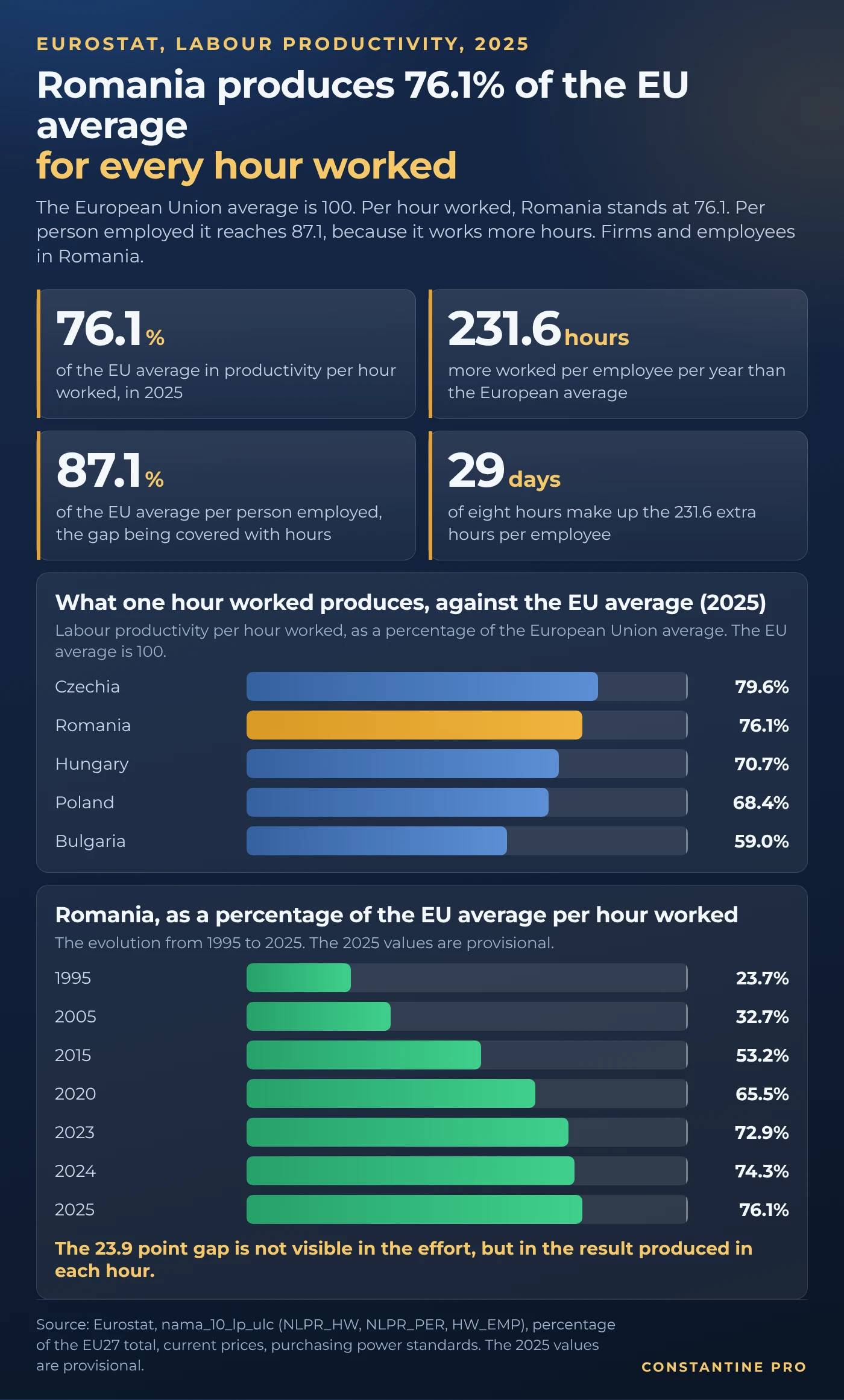
In 2025, labour productivity per hour worked in Romania was 76.1% of the European Union average, while productivity per person employed was 87.1%. The gap is covered with hours: each employee in Romania worked 1,835.8 hours against an EU average of 1,604.2, that is 231.6 hours more.

- Published
- Updated
In 2025, labour productivity per hour worked in Romania was 76.1% of the European Union average, while productivity per person employed was 87.1%. The difference between the two figures is easy to explain: the same work is spread over more hours. Each employee in Romania worked 1,835.8 hours in 2025, against an EU average of 1,604.2 hours, that is 231.6 hours more, almost 29 working days of eight hours. The figures come from the Eurostat national accounts, and the 2025 values are provisional.
Listen to the summary
Two measurements, two different answers
Eurostat publishes labour productivity in two ways: per hour worked and per person employed. Both are reported against the European Union average, which is 100. In 2025, Romania looked like this.
| Measure | European Union | Romania | Difference |
|---|---|---|---|
| Labour productivity per hour worked (EU = 100) | 100 | 76.1 | 23.9 points |
| Labour productivity per person employed (EU = 100) | 100 | 87.1 | 12.9 points |
| Hours worked per employee per year | 1,604.2 | 1,835.8 | 231.6 hours |
Per hour, the gap to the European average is 23.9 points. Per person, the gap falls to 12.9 points, because an employee in Romania works more hours a year than the EU average employee. In other words, the productivity gap is not visible in the effort made, but in the result produced in each hour.
The gap is covered with hours, not with output
231.6 hours a year means, at an eight-hour working day, almost 29 extra working days per employee. Those are paid hours that go into the firm's cost and do not show up in the result. Part of them goes to repetitive work: reading and entering data, copying information from one program into another, tracking deadlines, answering the same questions. That is exactly the part of the work a digital employee can take over.
The recovery of the last three decades
In 1995, labour productivity per hour worked in Romania was 23.7% of the European Union average. In 2025 it is 76.1%. The gap closed by 52.4 points, and the pace accelerated in the last decade.
| Year | Romania, as a percentage of the EU average (per hour worked) |
|---|---|
| 1995 | 23.7% |
| 2005 | 32.7% |
| 2015 | 53.2% |
| 2020 | 65.5% |
| 2023 | 72.9% |
| 2024 | 74.3% |
| 2025 | 76.1% |
In ten years, from 2015 to 2025, Romania recovered 22.9 points. In 2023 and 2024 the advance was faster than in the years before, and 2025 continues the trend.
Where we stand next to our neighbours
In 2025, productivity per hour worked, as a percentage of the European Union average, looked like this in the region: Czechia 79.6%, Romania 76.1%, Hungary 70.7%, Poland 68.4%, Bulgaria 59.0%. Romania has moved ahead of Poland and Hungary, but remains below Czechia and below the European average. So this is not a matter of a small country or a region, it is a difference in how work is organised.
What it means for a small firm
For a small firm, productivity is not a statistics debate. It is how much each person produces in the hours the firm pays for. The gap between 76.1% and 100% is not solved by asking the team to work more, because the team already works 231.6 hours above the European average. It is solved by taking repetitive work out of the equation, the work that consumes hours without adding anything to the result.
We measure exactly that, before and after a pilot: how many hours a week a process consumes, and how many remain after a digital employee takes it over. We do not report estimated percentages, but hours counted on the same tasks. The infrastructure the digital employees run on is the Constantine cloud, managed by us. The data, the procedures and the control stay with the client.
What stays human
A digital employee takes over the repetitive part: reading, comparing, entering, tracking deadlines, answering the questions that repeat. Decisions, negotiation, exceptions and the client relationship stay with people. Nobody changes how a firm works because of a statistics article, but every owner knows how many hours the team loses on things that repeat. That is where the gap between 76.1% and 100% is recovered.
How we start
We start with a 30-minute audit, where we look at the firm's processes together. A written proposal follows, then a two-to-three-week pilot in which we measure the hours before and after. The form is on the contact page of the site.