

What firms do with AI: 35.16% use it for administration, 32.86% for sales. Text generation stays at 3.12%
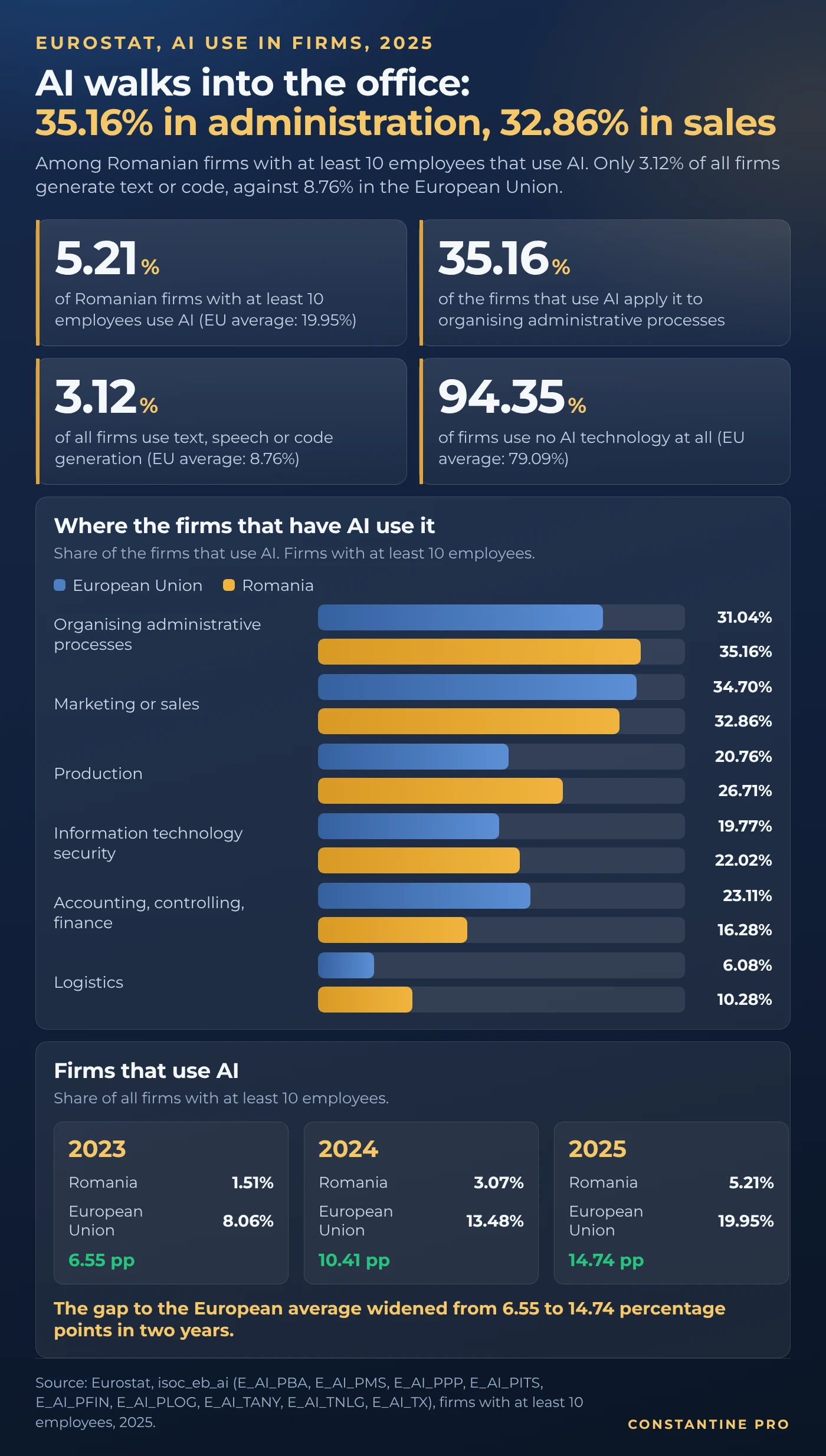
In 2025, 5.21% of Romanian firms with at least 10 employees used AI, against an EU average of 19.95%. Among those that use it, 35.16% apply it to organising administrative processes and 32.86% to marketing or sales. Only 3.12% of all firms use text, speech or code generation, and 94.35% use no AI technology at all.

- Published
- Updated
In 2025, 5.21% of Romanian firms with at least 10 employees used at least one artificial intelligence technology. The European Union average is 19.95%. The figures come from the Eurostat survey on the digital society. The small number hides a more useful question for a small office: what do the firms that crossed the threshold actually do? The data gives a simple answer. AI goes into office work, not into spectacular things.
Listen to the summary
The headline number stays small, but grows fast
Romania went from 1.51% in 2023 to 5.21% in 2025, that is 3.45 times more firms in two years. The European Union grew in the same period from 8.06% to 19.95%, 2.47 times. Romania's relative pace is better, but the gap in percentage points widened, because every point one side gains is harder to recover when the starting base is small.
| Year | Romania | European Union | Gap |
|---|---|---|---|
| 2023 | 1.51% | 8.06% | 6.55 points |
| 2024 | 3.07% | 13.48% | 10.41 points |
| 2025 | 5.21% | 19.95% | 14.74 points |
The number that matters for a small firm is not the adoption rate, but where the tool lands once it enters the firm. Here the data becomes concrete.
Where AI enters a firm
Eurostat asks the firms that use AI in which area of their activity they use it. The shares below are calculated from all firms that use AI, not from all firms.
| Area of activity (2025, firms with at least 10 employees) | Romania | European Union |
|---|---|---|
| Organising administrative processes | 35.16% | 31.04% |
| Marketing or sales | 32.86% | 34.70% |
| Production | 26.71% | 20.76% |
| Information technology security | 22.02% | 19.77% |
| Accounting, controlling, finance | 16.28% | 23.11% |
| Logistics | 10.28% | 6.08% |
Romanian firms that use AI put the organising of administrative processes first, exactly the office work that repeats. Marketing and sales come next. Accounting and finance stay below the European average, at 16.28% against 23.11%, even though electronic invoicing is already mandatory, which shows that the step from an obligation to an automated process does not happen on its own.
Text generation and images are only starting
The same data shows which technologies firms use, this time from all firms, not from those that use AI. Text, speech or code generation, exactly what a digital employee can take over today, is used by 3.12% of Romanian firms, against 8.76% in the European Union.
| Technology used (2025, firms with at least 10 employees) | Romania | European Union |
|---|---|---|
| Generating text, speech or code | 3.12% | 8.76% |
| Generating images, video or sound | 3.03% | 9.55% |
| Machine learning for data analysis | 2.69% | 5.10% |
| No AI technology at all | 94.35% | 79.09% |
The widest gap is not in the heavy technology, but in the cheap one. Text generation is the most accessible form of AI for a small firm, and Romania is at one third of the European average. This is where an office with a few people can recover hours of repeated work fastest.
Who sets AI up
Data from 2024 shows how AI reaches the firms that use it. At European level, 57.92% use it as commercial software ready to use, 28.60% receive it developed or modified by external providers, and 21.78% develop or modify it with their own employees. Romania does not report this module, so here we are talking about the European average.
Almost six in ten firms use AI as it comes out of the box. They do not build their own tools and do not hire people to build them. This says something simple: for a small firm the realistic question is not how to build a system on its own, but who delivers a worker that is ready to go.
What this means for an office with a few people
Put together, the figures describe a small firm where AI came in through the back door: into administration and sales, with tools bought ready made, not built in house. The area left uncovered is exactly the work that links people and programs, that is picking up a request, reading it, filling in a field, sending a reply, chasing a missing document. It is the work nobody has time to finish and which does not show up in any statistic, because it is not one technology, but a sequence of steps.
This is where a digital employee comes in. It does not ask the firm to learn a new tool. It receives a route described step by step, runs it on the firm's data and puts the result in front of a person.
A concrete flow: requests that arrive by email
In a small office, most requests arrive at the general email address: quote requests, order confirmations, questions about invoices, partially sent documents. Someone reads them, decides what is urgent, fills in what is missing, answers the ones with a standard reply and sends back the rest.
The route a digital employee can carry has five steps:
- read every new message from the firm's address;
- classify it by type: quote, order, invoice, complaint, supplier;
- extract the data that matters: who writes, what they ask for, which document is missing;
- prepare a standard reply for the types that repeat and put it in front of a person;
- escalate to a person anything that does not fit a known type.
The person no longer reads an empty box. They open a summary with requests already sorted and approve or correct. What is gained is measured in hours: the time spent reading and sorting messages, looking for missing documents and writing the replies that repeat month after month.
What stays with people
The decision stays. Who gets a discount, how a complaint is handled, what is promised to an important client. The digital employee prepares the ground and clears the repetitive work out of the way, but does not decide in the firm's place. The relationship also stays: an unhappy client wants a person, not an automatic reply.
How it starts
The first step is not a technology purchase, but a description. Take a flow that repeats, such as sorting requests, and write down in simple steps how it is done today, which decisions are made and where it gets stuck. From that description the digital employee's route is built and the hours the firm recovers in an ordinary month are measured.
If you want to see where time is lost in a firm like yours, write to us through the form on the site and we start from a single flow.