

Cloud in small firms: 24.94% pay for it. The European average is 52.74%
In 2025, 24.94% of Romanian firms with at least 10 employees paid for cloud services, against an EU average of 52.74%. Only 6.21% use the cloud to run their own processes, and that is where automation starts.

- Published
In 2025, 24.94% of Romanian firms with at least 10 employees paid for cloud computing services. The European Union average is 52.74%, more than twice as high. Finland (79.21%), Italy (75.60%) and Malta (74.87%) lead the ranking, while Bulgaria (17.83%) and Greece (24.33%) sit at the bottom. The figures come from the Eurostat survey on the use of cloud computing in enterprises, published in February 2026.
Listen to the summary
The figure describes the infrastructure everything else runs on. Software that works in place of a person needs somewhere to run on its own, without anyone switching on a computer. That place is the cloud. So I looked at what firms actually pay for, not just at how many pay.
The gap to the European Union has not narrowed
In 2023, 18.40% of Romanian firms used paid cloud services, against an EU average of 45.32%. In 2025, the figures are 24.94% and 52.74%. The gap grew from 26.92 to 27.80 percentage points. Both went up, but they did not move closer.
What the figure measures, and who it leaves out
The Eurostat survey starts at firms with 10 employees. Micro-enterprises, which account for more than 90% of Romanian firms, are not measured at all, and SMEs make up 99% of active firms. The real share, counted across all firms, is therefore lower than 24.94%. The published number is a generous ceiling: three out of four measured firms pay for no cloud service at all.
What Romanian firms pay for in the cloud
| Paid cloud service | Romania | EU |
|---|---|---|
| 21.95% | 44.91% | |
| Office software | 16.68% | 37.81% |
| Storage of files | 17.54% | 37.73% |
| Security software | 16.46% | 34.54% |
| Accounting software | 16.27% | 30.68% |
| Computing power for own applications | 7.52% | 14.86% |
| Platform for development, testing, running | 6.21% | 13.76% |
| At least one sophisticated service | 18.86% | 40.89% |
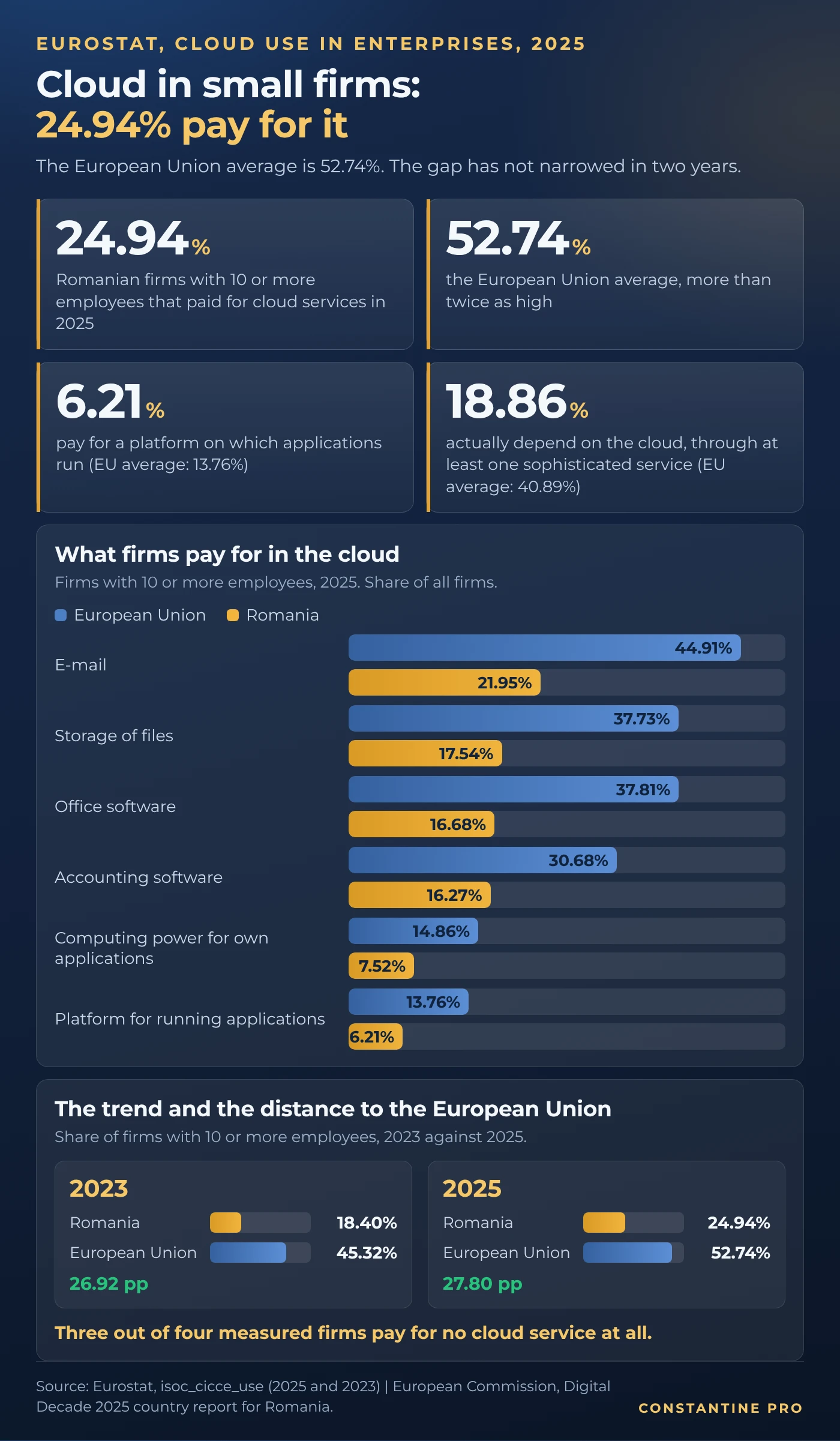
The last row is the one that matters here: it counts the firms that actually depend on the cloud, not the ones that simply moved a mailbox online.
The line between an archive and a process
E-mail, files and accounting software hosted in the cloud mean the data no longer sits on the office computer. That is a real step, but it is a step towards an archive: someone still has to open the application and work inside it.
An automated process needs something else: the ability to run code without depending on a computer being switched on, on a working day, or on someone pressing a button. Romanian figures are lowest exactly here, at 7.52% and 6.21%, against EU averages of 14.86% and 13.76%.
The natural order is this: first the data moves to the cloud, then the process that works with it can run there. Without the first step, the second has nowhere to happen.
What such a process looks like in a small office
A small firm receives quote requests by e-mail, through the form on its website and by phone. Every request goes through roughly the same steps: read, checked for missing details, looked up in the history to see whether the customer is an existing client, a reply prepared with the company details, a call scheduled. One person does this between ten other things, usually at the end of the day.
What can run on its own: picking up the request from every channel, extracting the details, checking the history, preparing the reply and putting it in front of the person. What stays with the person: the price, the negotiation, the promised deadline, the relationship with the customer.
The repetitive part moves to the cloud. The part that is a decision does not.
The first step is not buying software. It is measuring: how many minutes each step takes today, who performs it, how many requests arrive in a week. Without those three numbers, any conversation about automation stays an opinion.
What the European Commission says about Romania
The European Commission's 2025 country report for Romania notes that the digitalisation of firms remains below the EU average, especially among small and medium-sized enterprises, and recommends increasing the uptake of cloud and artificial intelligence. The European target for 2030 is for 75% of firms in the Union to use cloud computing, data analytics or artificial intelligence.
The bottleneck is not the internet. Romania has one of the best fixed networks in the Union, and 99% of European firms have internet access. The difference lies in what is bought on top of that network.
What stays with people
- The decision to send a reply, or not to send it.
- The exception, meaning the request that resembles nothing in the history.
- The price and the negotiation.
- The relationship with the customer and the context that is written down nowhere.
- Responsibility for whatever leaves the company.
Those five things are not automated. The rest, often, can be.
The infrastructure
The processes run in the Constantine cloud, administered by us. The firm keeps the process to define, the data to supply and the decision to approve every result. No infrastructure to own in the office, nothing installed on employees' computers, no data sitting on a single office machine.
If you want us to look together at how many minutes the repeating steps take in your firm today, write to us through the form on the site.