

Small firms have no IT person: 13.16% employ a specialist. The EU average is 20.05%
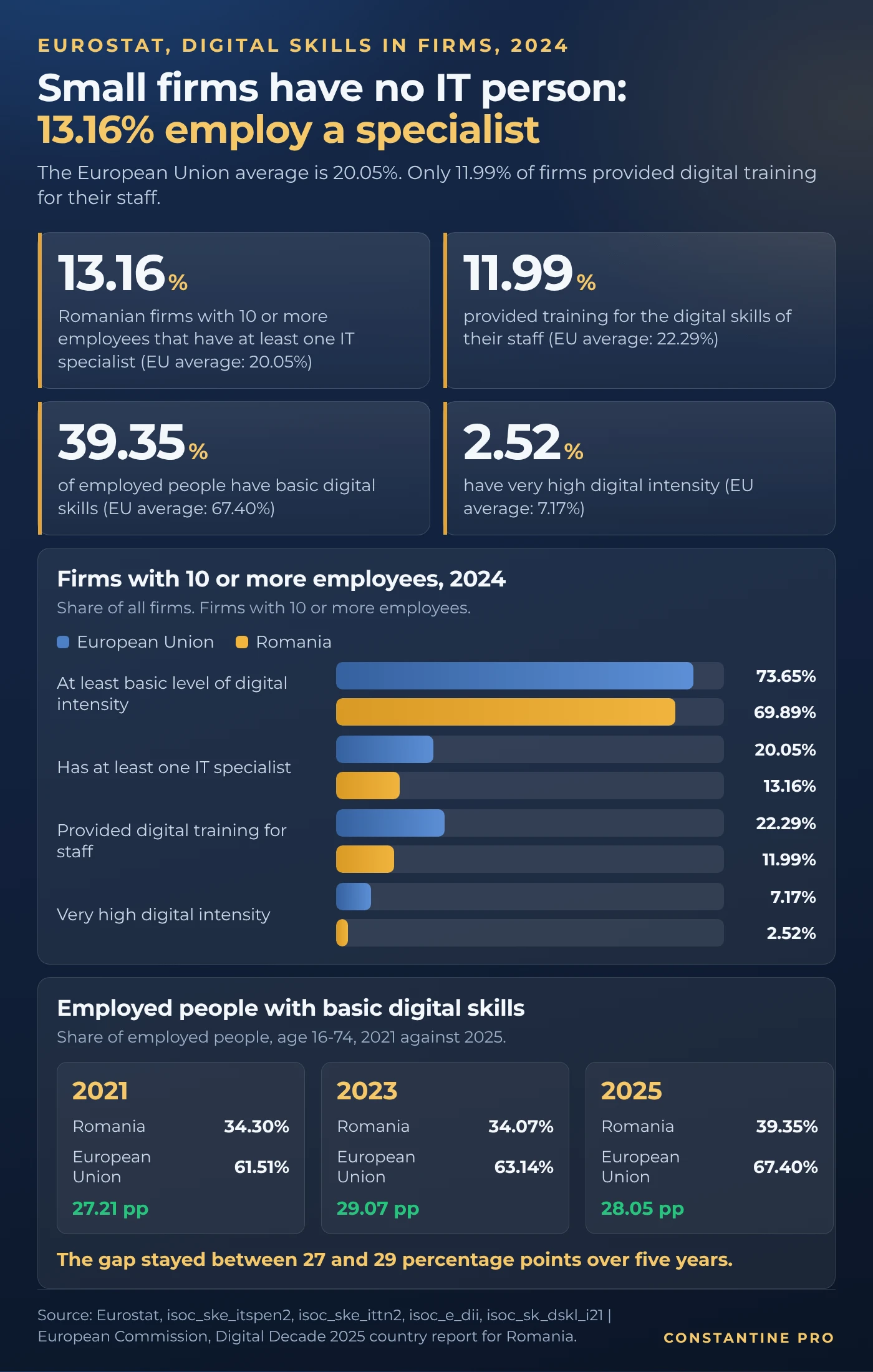
In 2024, 13.16% of Romanian firms with at least 10 employees had an IT specialist, against an EU average of 20.05%. Only 11.99% provided digital training for staff, and 39.35% of employed people had basic digital skills, against 67.40% in the European Union.

- Published
In 2024, 13.16% of Romanian firms with at least 10 employees had at least one information technology specialist. The European Union average is 20.05%. In the same survey, only 11.99% of Romanian firms had provided any training for the digital skills of their staff, against 22.29% in the EU. The figures come from the Eurostat digital society survey, with a reference year of 2024.
Listen to the summary
Those two numbers describe the same reality in a small office. Nobody in the firm has technology as a trade, and the people who work there were not trained for it. When a new tool arrives, there is no one to set it up and look after it in the second month.
It is not a lack of interest, it is a consequence of size
Almost all firms in Romania are small and medium enterprises, and more than 90% are micro-enterprises. In a firm with five or fifteen people there is no IT position, and it would make little sense for one to exist. The salary of a technical person exceeds the value of a process that repeats a few times a day. The figure of 13.16% does not say that small firms do not want technology. It says they cannot justify a person dedicated to it.
Who actually works with technology
The absence of an IT person would matter less if the people in the firm could use digital tools on their own. The data shows a different picture. In 2025, 39.35% of employed people in Romania had basic or above basic digital skills, against 67.40% in the European Union.
| Year | Romania | European Union | Gap |
|---|---|---|---|
| 2021 | 34.30% | 61.51% | 27.21 points |
| 2023 | 34.07% | 63.14% | 29.07 points |
| 2025 | 39.35% | 67.40% | 28.05 points |
Romania moved from 34.07% to 39.35% in two years, faster than the European average, which rose from 63.14% to 67.40%. The gap, however, stayed between 27 and 29 percentage points. In the European Union, more than 1.7 times as many employed people have basic digital skills as in Romania.
What basic digital skills mean
Eurostat measures five areas: information, communication, content creation, safety and problem solving. Someone has basic skills if they manage at a minimum level in all five. This is not about programming. It is about looking up information, sending a document, filling in a table, recognising a misleading message and solving a simple problem with a program. In other words, exactly ordinary office work.
The same firm, seen from the other side
| Indicator (firms with 10 or more employees, 2024) | Romania | EU |
|---|---|---|
| Has at least one IT specialist | 13.16% | 20.05% |
| Provided digital training for staff | 11.99% | 22.29% |
| Very high digital intensity | 2.52% | 7.17% |
| At least basic level of digital intensity | 69.89% | 73.65% |
The last row says that most Romanian firms have crossed the minimum threshold. The first row says that almost none of them has someone to take things further. Firms enter digitalisation but stay at the basic level, because there is no one to push the next step.
A digital employee does not require the firm to become technical
This is where the question changes. Not how do we teach employees to program, but who takes over the steps that repeat. A digital employee is not a program the firm has to learn to use. It is a doer: it receives a defined route, runs it on the firm's data and puts the result in front of a person.
The firm is not asked to become technical, and employees are not asked to learn a new language. They are asked for something simpler: for someone to say, step by step, how that piece of work is done today.
A concrete flow: appointments
A service firm receives booking requests by e-mail, by phone and through a form. Every request goes through the same steps: read, check availability, put it in the calendar, send the confirmation, send a reminder the day before, handle the reschedule. A person does this among ten other things.
What can run on its own: taking the request from every channel, checking availability, writing to the calendar, the confirmation and the reminder. What stays with the person: the decision to accept the booking, the exception that does not fit the pattern, the relationship with the client.
The first step is not buying a program. It is measuring: how many bookings come in during a week, how many minutes each step takes, who does it today. Without those three numbers, any discussion about automation stays an opinion.
What stays with the person
- The decision to accept or to refuse.
- The exception, the request that looks like nothing in the history.
- The price and the negotiation.
- The relationship with the client and the context that is written down nowhere.
- Responsibility for what leaves the firm.
Those five things are not automated. The rest, often, can be.
The infrastructure
The processes run in the Constantine cloud, administered by us. The firm keeps the work of defining the process, supplying the data and deciding to approve each result. With no IT person in the firm, with no installations on employee computers and with no data sitting on a single office machine.
If you want us to look together at how many steps repeat in your firm today and how many minutes they take, write to us through the form on the website.