

RO e-Factura: 1.24 billion invoices in 2025. What stays manual in a small office
The national system processed 1.24 billion invoices in 2025, and 70.4% of ANAF's sanctions on digital systems were for RO e-Factura. Which workflow a small company can actually automate.

- Published
- Updated
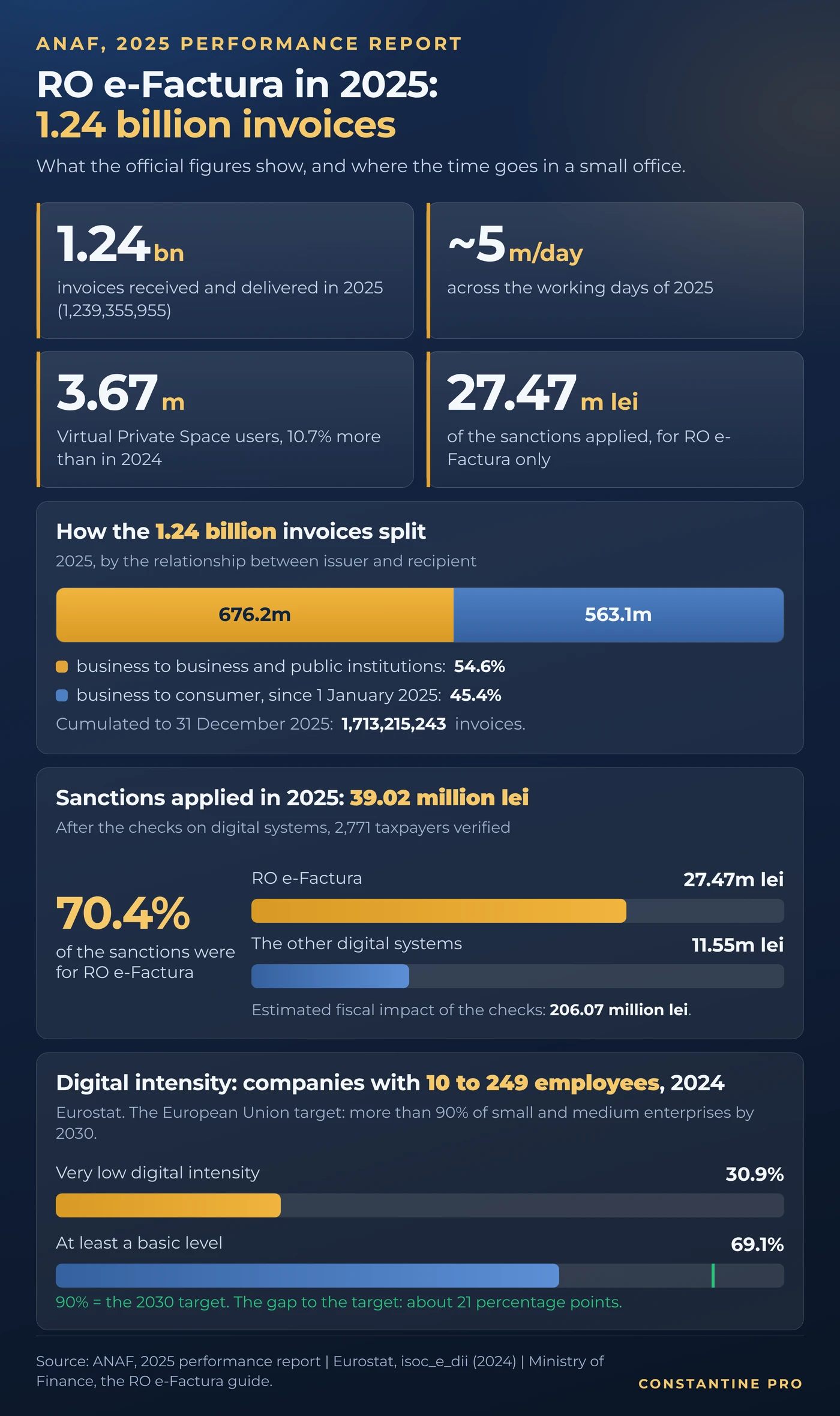
The national RO e-Factura system processed 1,239,355,955 invoices received and delivered in 2025. From launch to 31 December 2025 the cumulative total reached 1,713,215,243. Both figures come from ANAF's 2025 performance report.
Listen to the summary
Divided by the working days of the year, that is roughly 5 million invoices a day. For each one, a small company repeats the same route: issue, check, convert to XML, transmit, watch whether it was accepted or rejected, correct it if rejected, then record it in accounting.
The figure does not describe a change of software. It describes a change of process, and the process is what consumes the hours.
What the ANAF 2025 report shows
- 1,239,355,955 invoices received and delivered in 2025, of which 563,111,228 in the business-to-consumer relationship and 23,502,066 in the relationship with public institutions;
- 1,713,215,243 invoices cumulated from implementation to 31 December 2025;
- 3,671,845 users of the Virtual Private Space, 10.7% more than in 2024;
- 2,771 taxpayers checked on the use of digital systems, with an estimated fiscal impact of 206.07 million lei and applied sanctions of 39.02 million lei.
The extension of the obligation to the business-to-consumer relationship, in force since 1 January 2025, is what drove the growth: invoices issued to individuals entered the same system in which company-to-company invoices already circulated.
The rule that changes the workflow, not just the software
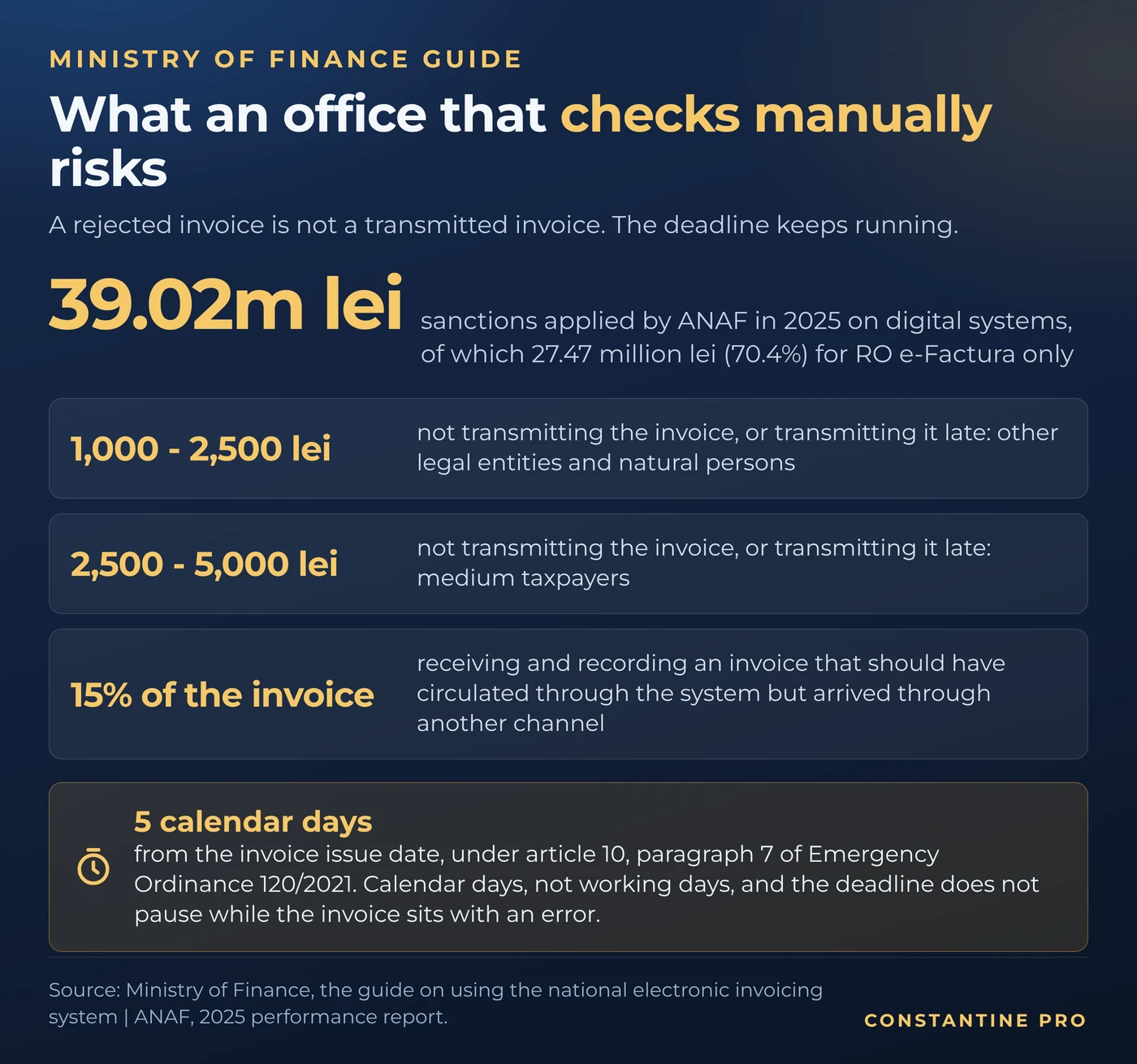
The deadline for transmission is 5 calendar days from the invoice issue date, under article 10, paragraph 7 of Emergency Ordinance 120/2021 and the clarification published by the Ministry of Finance. Calendar days, not working days: an invoice issued on Thursday comes due on Tuesday, weekend included.
The detail that causes the most trouble is not the deadline, but the status of a rejected invoice. An invoice rejected by the system is not a transmitted invoice. It has to be corrected and sent again within the same deadline, and the deadline does not pause while the document sits with an error. An office that checks the status manually once a day ends up learning about the rejection on the last available day, or after it.
The cost of errors is not hypothetical
In 2025 ANAF applied 39.02 million lei in sanctions following its checks on digital systems. 27.47 million lei, or 70.4% of the total, were for non-compliance with RO e-Factura rules.
The sanction scales apply by taxpayer category (Ministry of Finance guide):
- non-transmission or late transmission: 1,000 - 2,500 lei for other legal entities and natural persons, 2,500 - 5,000 lei for medium taxpayers;
- receiving and recording an invoice that should have circulated through the system but arrived through another channel: a fine equal to 15% of the invoice total value.
The second point concerns the buyer, not only the issuer. A company that records an invoice received by email without checking whether it passed through the system pays a fine proportional to the invoice value, not to the verification effort it saved.
It is not a software problem, it is a process problem
Eurostat data for 2024 shows that 30.9% of Romanian companies with 10 to 249 employees had a very low digital intensity, while 69.1% reached at least a basic level. The European Union target is for more than 90% of small and medium enterprises to reach that level by 2030.
In other words: most small companies already have invoicing software that talks to the system. What they do not have is the workflow around it. The document arrives by email, lands on a desk, someone saves it, someone types it into the ERP, someone asks whether the invoice was accepted. The software handles one step; the rest of the steps stay manual.
The concrete workflow, step by step
The accounting workflow we publish has seven steps. Five of them can be taken over by a digital employee; two stay with a person.
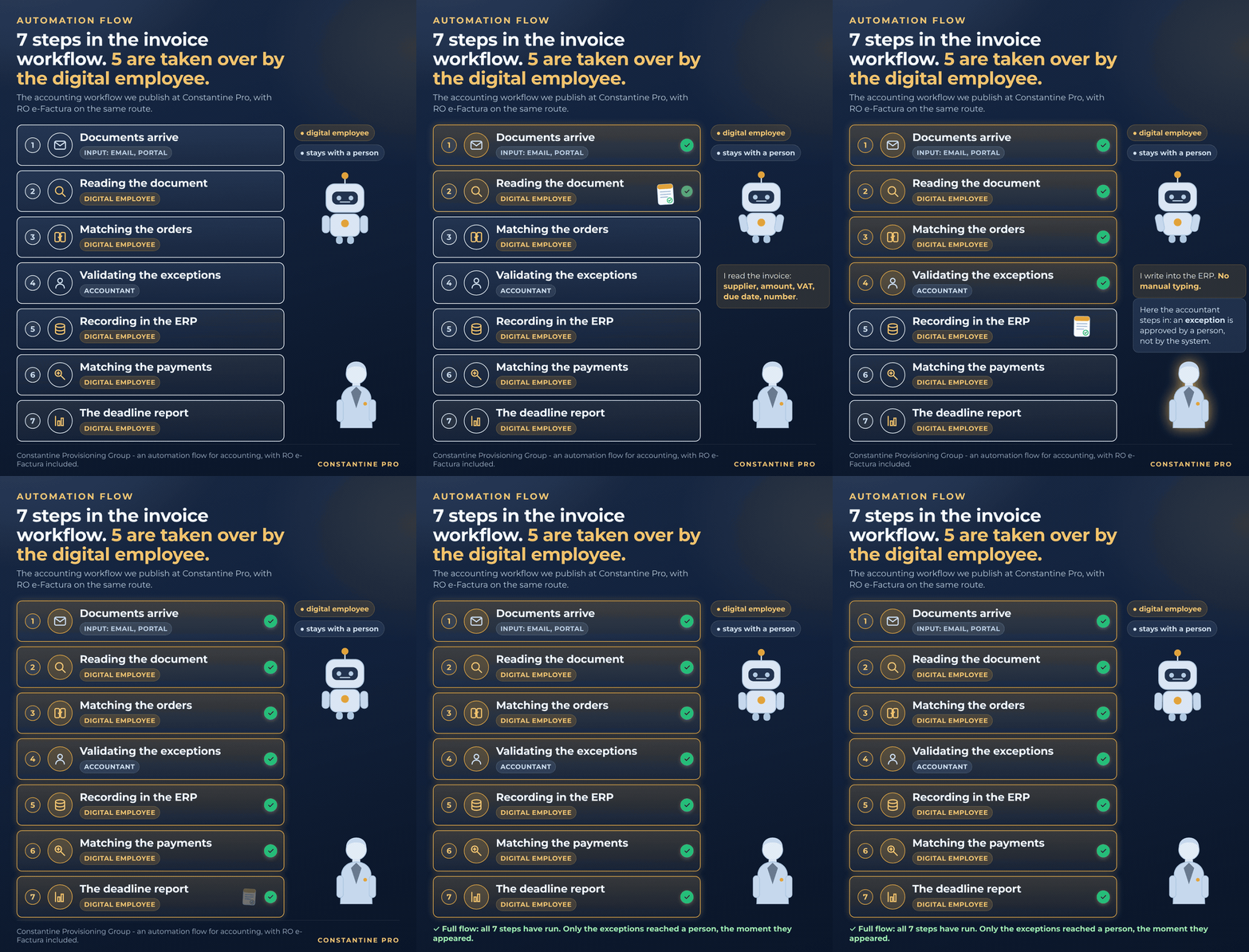
- Documents arrive by email or in the portal - supplier.
- Reading the document: supplier, amount, VAT, due date, invoice number - digital employee.
- Matching against existing orders and contracts - digital employee.
- Human validation of the exceptions - accountant.
- Recording in the ERP, without manual typing - digital employee.
- Matching payments against outstanding invoices - digital employee.
- Reporting deadlines and differences - digital employee, verified by a person.
For RO e-Factura specifically, the digital employee takes over exactly the steps that carry no decision: generating the file, transmitting it, watching the accepted or rejected status, resending after a correction, and notifying the person at the moment of rejection rather than at the end of the day.
What stays with a person is explicit: who approves a payment, who accepts an exception, who is accountable for a disputed invoice. Automation does not move the responsibility, it moves the effort.
How it is measured
We do not promise financial return. It is measured before and after, in hours: how much time the invoice workflow consumes per month, how many invoices meet the deadline, how fast a rejection is corrected, how long it takes from an invoice arriving to it being recorded in the ERP. Whatever stays manual is stated at the start, not at the end, and the infrastructure runs in the Constantine cloud, administered by us.
A system processing 1.24 billion invoices a year is no longer a fiscal novelty. It is the daily routine of every company, and routine is exactly the part that can be delegated.